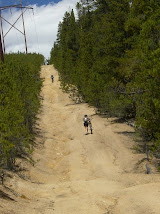
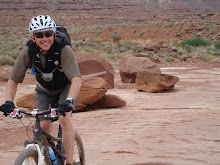
You may recall that Phil celebrated his 50th year by buying a couple new bikes, which we - tongue in cheek - refer to as the Wife Beaters.
After serious consideration, I have decided to even the playing field once again.
Sometime this week I plan to place my order for a new mountain bike. We shall call my new toy what it is meant to be – Man Killer. Grrrr!
This is a Pivot Mach 4 dual suspension mountain bike. The women’s specific frame colors available from the manufacturer are baby blue and pink. When will sporting equipment manufacturers realize that just because they “shrink it & pink it” they are not catering to the female athlete?
Anyway, as luck would have it, the size frame I need (an XXSmall) has the same frame geometry, whether you buy the “women’s” version or the standard version. So, thank goodness, I can get a black anodized frame rather than a pink one.
A pinkMan Killer lacks a certain gravitas, don’t you think?
Details on my component selection will follow. I plan to build this baby so light it floats uphill without any help from me! The local bike shop is about to have a very lucrative month . . .
One of the reasons I whine about working out in the cold weather is that I have exercise-induced asthma (most of the other reasons involve being a certified wimp, but we don't need to discuss that . . .!)
A recent article in the New York Times notes that exercise-induced asthma has been diagnosed in as many as half of all elite cross-country skiers and almost as many world-class ice skaters and hockey players.
Cynics believe the high incidence of asthma in world class athletes is tied to the fact that an asthma diagnosis gives them access to performance-enhancing drugs, such as Clenbuterol and Salbutamol. More objective observers have other hypotheses.
Exercise-induced asthma is not quite the same condition as asthma. And in fact, these days, the “preferred term” in the scientific community for exercise-induced asthma is exercise-induced bronchoconstriction, or E.I.B. It’s a reversible, obstructive airway disease that typically begins about five minutes after you stop exercising — particularly if your exercise was intense, at between 85 and 95 percent of maximum heart rate.
Historically researchers believed that exposure to cold air was what triggered the bronchial narrowing, with blood vessels in the throat constricting to conserve warmth, just as they do in ungloved fingers; when the vessels later reinflated, they were thought to ignite spasms in the bronchial tubes, like tingling in warming fingers.
But most researchers no longer consider it to be the primary cause. Instead, most experts think that the problem is not with the coldness of the air but with the “dryness.” Lungs need water-saturated air. If the air entering your bronchial tubes is dry, as it usually is in winter, the cells lining your airway release their own moisture to humidify it. The squeezing and loss of moisture prompt certain cells within the bronchial tube to release allergic chemicals that initiate an inflammatory process, slowly closing your throat.
While it is miserable (and probably not pleasant for anyone in the vicinity as I hack like a 3-pack a day smoker), it isn't life-threatening.
If we are going to continue these cold-weather training rides, I may have to consider getting one of these:
[it will also come in handy if I decide to start a life of crime robbing convenience stores and banks . . .]
Totally unrelated, but just too funny not to share . . .
I see life as an adventure with no guarantees. Favorite Quote "Security is mostly superstition. It does not exist in nature. Life is either a daring adventure or nothing." Helen Keller